
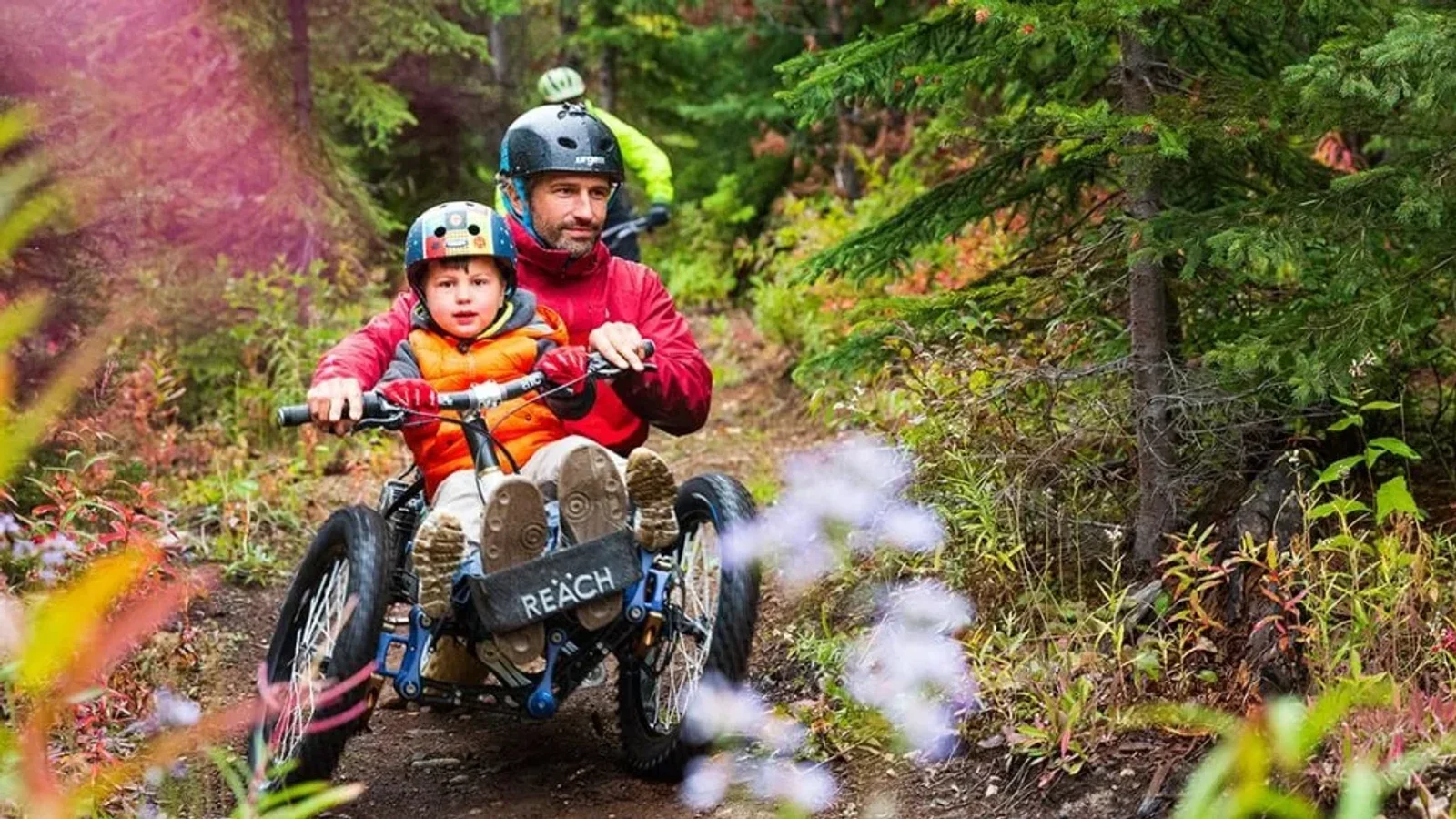
The Bowhead Reach can open demanding trails to riders who need an adaptive, hand-powered platform, but the machine is only one part of the experience. This first-person ride shows why seating, controls, terrain, transport, and individual function must be considered together before anyone decides whether an adaptive bike is the right fit.
Author: Seth McBride — New Mobility Magazine, July 1, 2019
I drive north to see a guy about an adaptive bike. 850 miles, one international border, five cups of coffee and a night sleeping in the back of my car on the edge of a quiet lake in Central British Columbia. It's a long way to go for a test ride, but then again, Christian Bagg isn't selling just any bike.
Bagg, 44, is the founder of Bowhead, a company that makes adaptive off-road bikes. He's also a C6-7 quad — he was paralyzed in a snowboarding accident at age 21. He's been building these bikes in his garage in Kelowna, BC, for 17 years, and the Reach, his first mass-produced model, is unlike anything I've ever ridden.
The Reach is a hand-powered, three-wheeled recumbent bike designed for off-road use. It has a carbon fiber frame, full suspension, and hydraulic disc brakes. The rider sits low, almost on the ground, and uses a hand crank to drive the rear wheel. The bike weighs about 45 pounds (roughly 20 kilograms) and can handle trails that would be impossible for a standard handcycle.
"It's not a disability product," Bagg says. "It's an adventure sports product. The difference matters."
Bagg is a compact, intense guy with a quick smile and a tendency to talk with his hands — not easy to do from a wheelchair, but he manages it. He's been riding his own designs since the late 1990s, when he started building bikes in his parents' garage in Calgary. He studied mechanical engineering at the University of Calgary, and his thesis project was an early version of the Reach.
The company has grown slowly and deliberately. Bagg has bootstrapped it from the start, refusing outside investment. There are currently about 30 Reaches in the world, at prices ranging from $8,000 to $15,000 depending on configuration. Bagg expects to make about 50 this year, ramping up to 100 next year.
"I could have taken VC money and scaled up fast," he says. "But I didn't want to compromise the product. I wanted to make sure every bike was right."
The Reach has found its way to some remarkable places. There are Reaches on trails in New Zealand, in the Alps, in the mountains of Colorado. Some riders have taken them on multi-day backcountry trips. A few have entered them in adaptive mountain bike races.
I spend a day riding with Bagg on trails outside Kelowna. He's an effortless rider, spinning up climbs that leave me gasping. The Reach is genuinely fun to ride — fast and precise on the descents, surprisingly capable on loose rock and roots.
"The goal was always to make something that non-disabled people would want to ride," Bagg says. "If it's good enough for everyone, it's definitely good enough for people with disabilities."
He's also working on a new model, the Craft, designed for more casual trail riding. It will be lighter and less expensive than the Reach, aimed at riders who want to explore but don't need the full race-ready capability of the flagship bike.
Bagg is thoughtful about the tension between accessibility and performance. He wants to make bikes that are within reach of more people, but he's not willing to sacrifice the quality that makes the Reach special.
"The adaptive sports market is full of compromises," he says. "Products that are almost good enough, that work most of the time. I'm trying to make something that has no compromises. Something that's just good."
What the original ride revealed
Seth McBride's original Handcycle Heaven feature in New Mobility is valuable because it describes uncertainty as well as excitement. The Reach is presented through a real trail day, with attention to hand function, body position, climbing, descending, and the long trip required to try the bike. Those details matter more than a highlight reel because they show how performance depends on the rider, configuration, and environment.
Choose an adaptive trail setup as a system
Start with the Bowhead Reach product page for the current Moove overview, then compare it with the broader guide to adaptive recreation equipment. In Canada, Moove treats the bike, seating, controls, loading plan, intended trails, and service access as one configuration. Manufacturer specifications describe the platform; an individual fitting determines how that platform should be set up for a particular rider.
Arrange a fitting before choosing
An adaptive bike should be evaluated around the rider's goals and the places it will actually be used. Moove's fitting process can cover measurements, posture, control access, transport constraints, and questions to test during a demonstration. Use the contact form to describe the trails, distances, vehicle, and support available. No article can confirm suitability on its own, but it can help prepare a more useful fitting conversation.