
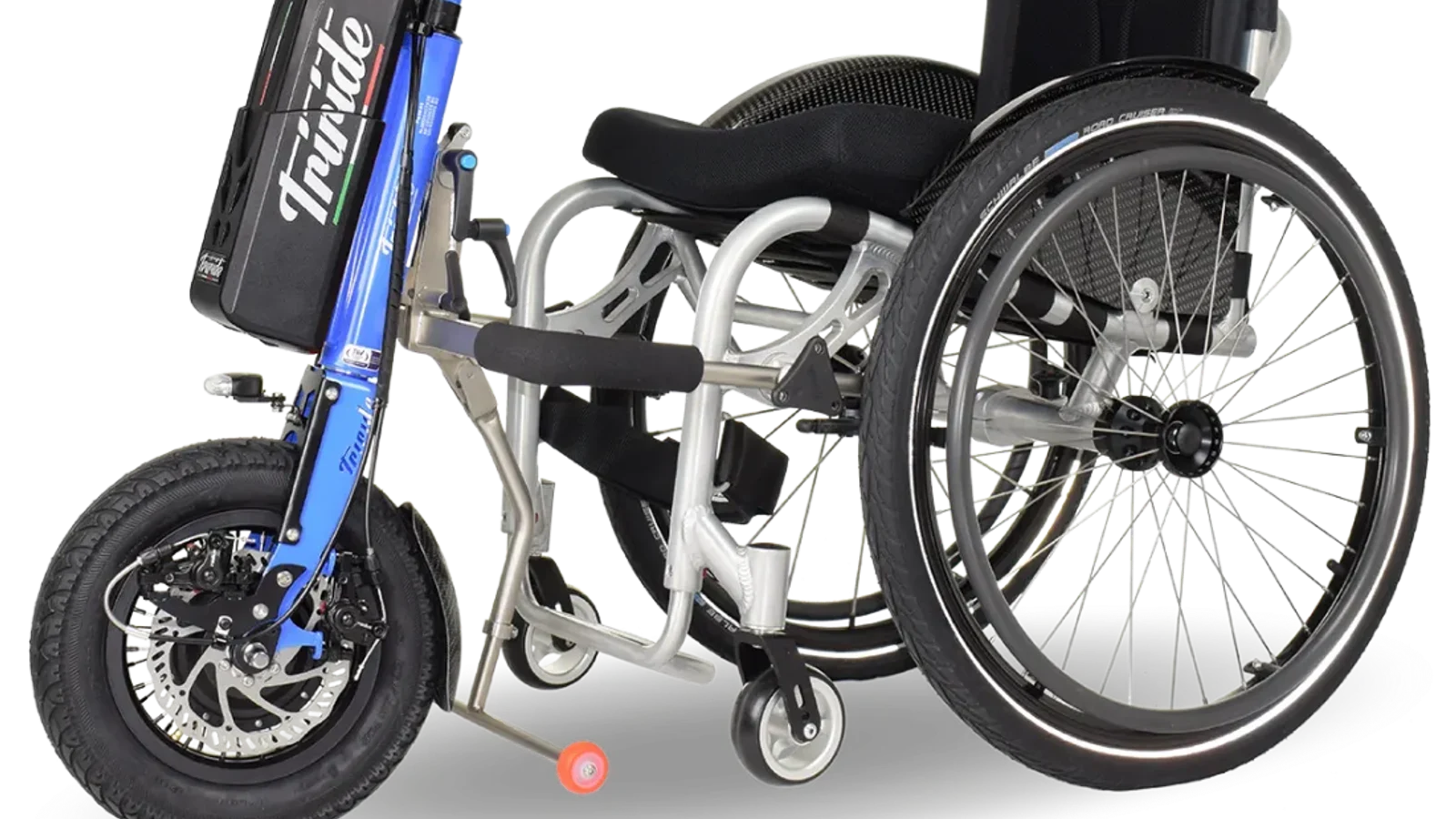
A Triride front power assist can add motorized propulsion and a steering wheel to a compatible manual wheelchair, helping with distance, hills, and varied outdoor routes. The correct model and setup depend on the wheelchair frame, attachment position, user controls, transport plan, terrain, and support needs, so compatibility and suitability should be confirmed through an individual fitting and demonstration.
The Triride is the new way for people in wheelchairs to move freely! It is an electric wheel equipped with a handlebar which is fixed on 90% of the manual and active manual wheelchairs. In a matter of seconds, he turns the manual wheelchair into a powerful scooter. It is a particularly compact system and can be mounted and dismounted quickly.
Moove is proud to be the exclusive Canadian distributor of Triride. The Triride was designed and manufactured in Italy and represents the finest in European adaptive mobility engineering.
The Triride attaches to the front of almost any manual wheelchair, transforming it into a powered vehicle capable of handling hills, rough terrain, and long distances that would otherwise be impossible to cover manually. The system weighs under 20 kg and folds compactly for transport.
For more information about the Triride and to arrange a demonstration, contact Moove. We bring the Triride directly to you for a personalized fitting and trial.
What a front power assist changes
A front attachment changes more than propulsion. It also changes steering, turning space, weight distribution, braking, transfers around the chair, and how the complete setup is loaded into a vehicle. The official Triride site describes the manufacturer's current product families and accessories. Published specifications are a starting point; they do not confirm compatibility with a specific chair or the way a particular person will use it.
Match the model to the route and chair
Review a representative model such as the Triride Light, then use Moove's guide to wheelchair power-assist options to compare front attachments with other approaches. In Canada, Moove considers daily routes, gradients, surfaces, weather exposure, storage, vehicle loading, hand access, braking, and service support during configuration. A lighter device is not automatically the best choice, and a more powerful device is not automatically suitable. Battery range also depends on the route, temperature, load, tire pressure, driving style, and battery condition. Published specifications are useful for comparison, but a real trip should include a reasonable reserve and a charging plan. Ask how the battery should be stored during Canadian winters, how replacement parts are sourced, and what support is available if the attachment or mounting hardware needs adjustment after delivery. A documented setup also makes future service conversations clearer when tires, seating, the chair, or travel routines change over time.
Compatibility must be checked
Frame-tube shape and dimensions, footrest clearance, caster lift, seating position, control reach, and attachment hardware all deserve direct inspection. Changes to the chair after purchase can also affect the setup. Moove's personalized fitting service documents the intended use and identifies questions that should be tested during a demonstration. The goal is not only to make the device attach, but to create a configuration that can be operated, transported, maintained, and supported safely.
Plan a demonstration
Bring the wheelchair that will be used, describe typical routes, and identify the vehicle or storage constraints before the appointment. During the trial, test attachment and removal, turning, stopping, slopes, uneven surfaces, control comfort, and the help available when something needs adjustment. Use the Moove contact form to share those details and ask about current Canadian availability. Product supply, configuration, and lead times can change, so confirm them directly rather than relying on an older article.